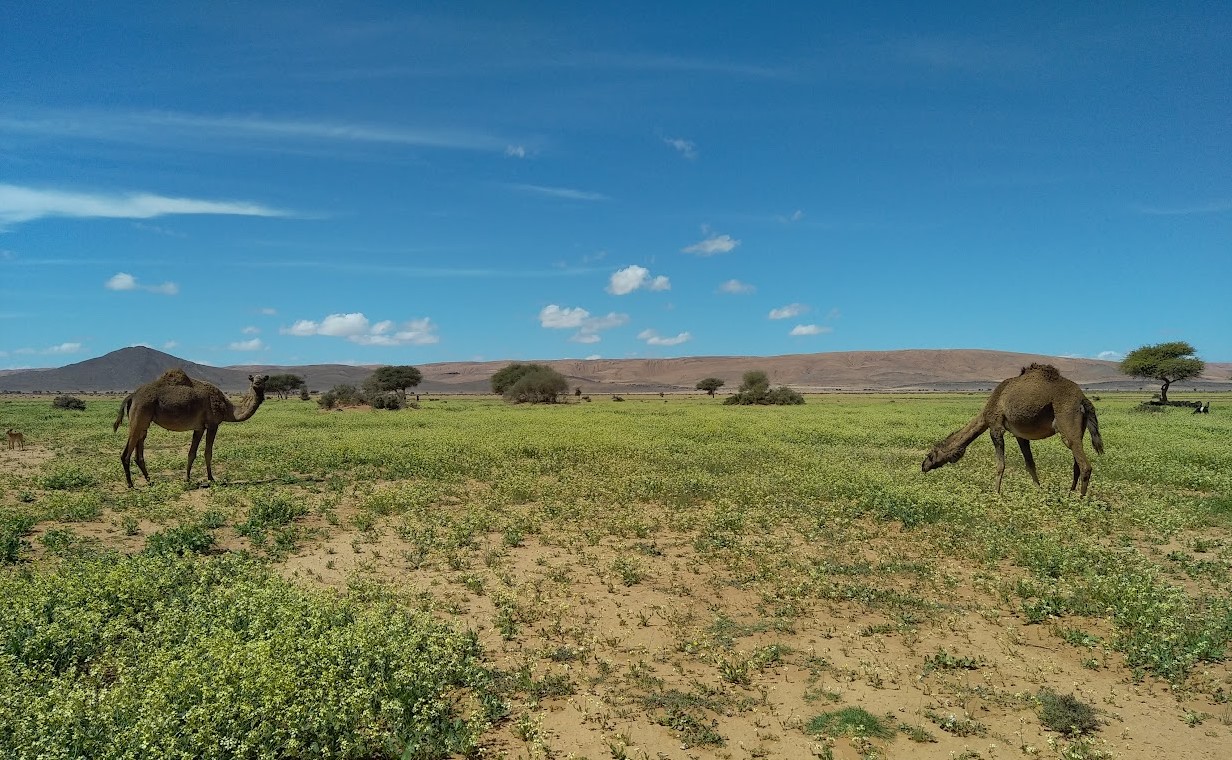
Image above: Two camels in pasture with Jbel Taïssa in the background, Photo B.P. 2026
Author: Bastien Pillon, Université Toulouse – Jean Jaurès, Toulouse, France. bastien.pillon.bp@gmail.com
Bastien is a recipient of the 2026 Bonte-Brisebarre gran
The Saharan region of Guelmim-Oued Noun is the northernmost of the three regions within the camel breeding area in Morocco (the others are Laayoune and Dakhla). The herders use their one-humped camels for the milk in the subsistence economy of their household. The meat allows them to get money when they sell one-year camels to butchers. The aim is to retain the herd which will be divided between the children when the father, the household had, dies. For a decade, entrepreneurs – mostly Westerners – have been joining the camel production sector and are transforming it. This new category of actors seeks to increase the value of camel milk by developing new products, such as bottled milk, yogurt, cheese, etc., to be sold in Morocco, with a view to later exporting their production toward Arab countries, and then Europe.
Local camel herders still partake in a traditional pastoral system “aimed at ensuring the long-term continuity of the lineages of humans and animals” (Schareika & al., 2021: 54). Conversely, entrepreneurs want to industrialise and modernise the camel sector, with a “aim of increasing monetary returns on investments” (ibid.). This capital logic previously did not exist in this sector and is slowly transforming it into an industry. Today, it is finding its way into the local system and is starting to replace the herders’ cattle logic of the herders and hybridising the sector.

Chaala-camel with her herder, Photo B.P. 2026
The Modes of Existence (Latour, 2012) of these two types of actors are bringing them into conflict in many ways. One of them concerns the way in which they build a relation with camels. Herders are in daily contact with their camels and name them after the colour of their coat. The relation is not individualised, except with camels of one of the eight main colours: the chaala. The chaala are the she-camels with which herders have a more individualised relation. These camels have white legs, and are considered quieter, kinder, gentler than the others. For example, one of the herders has a chaala, which he named “kind” in Hassaniya Arabic, because “she is kind before being red”. As for the entrepreneurs, they do not distinguish the camels according to colour, but according to their milk productivity. They criticise the “conservatism” of the herders and promote the “modernisation” that they consider embodying. Hence, they claim that they pay attention to “animal welfare” in their projects. For instance, one of them wants to build a “paddock paradise” in which there will be several shady enclosures with misting. Furthermore, the management of the food mix they gave to the camels is important: it must fit with the metabolic needs of the camels and depends on the seasons (about 10% more food during the summer), which is important, given global warming. The region received no rain between 2016 and 2025, impacting herds and herders. Entrepreneurs seem to favour technological fixes to respond to this situation. One of them explained that they must “compensate for aridity though a technical response”, along all the externalities involved.
The next stage of this research will focus on both camel herders and entrepreneurs. It will examine the subtleties of their everyday lives, the concrete ways in which they engage with and shape their relationships with camels, and the activities they pursue beyond the core practices of the camel industry. More specifically, it aims to explore how the modernisation of the camel sector, driven by entrepreneurs, is reshaping the lives and practices of all those involved. It will examine, for example, what herders do within their relationships with chaala, and how entrepreneurs negotiate with herders to secure access to their camels. It will also investigate the forms of resistance these actors encounter, as well as the ways in which they cooperate, negotiate, or come into conflict within the camel sector.
References:
Latour, B. (2012). Enquête sur les modes d’existence : Une anthropologie des modernes. La Découverte.
Schareika, N., Brown, C., & Moritz, M. (2021). Critical Transitions from Pastoralism to Ranching in Central Africa. Current Anthropology, 62(1), 53‑76.
About the author: I am a first-year Master’s student (M1) in Social and Cultural Anthropology at Université Toulouse – Jean Jaurès, France. This blog post summarizes my M1 thesis, entitled The White Paw of the Camel: An Ethnography of Relationships Between Herders, Entrepreneurs, and Camels in Morocco. As part of my research, I conducted two months of ethnographic fieldwork in the Guelmim–Oued Noun region of southern Morocco. My research primarily relied on participant observation of the everyday practices of camel herders and entrepreneurs, complemented by several semi-structured interviews with both groups. I will return to the field next year for an additional two to three months to further develop this research and complete my Master’s degree.