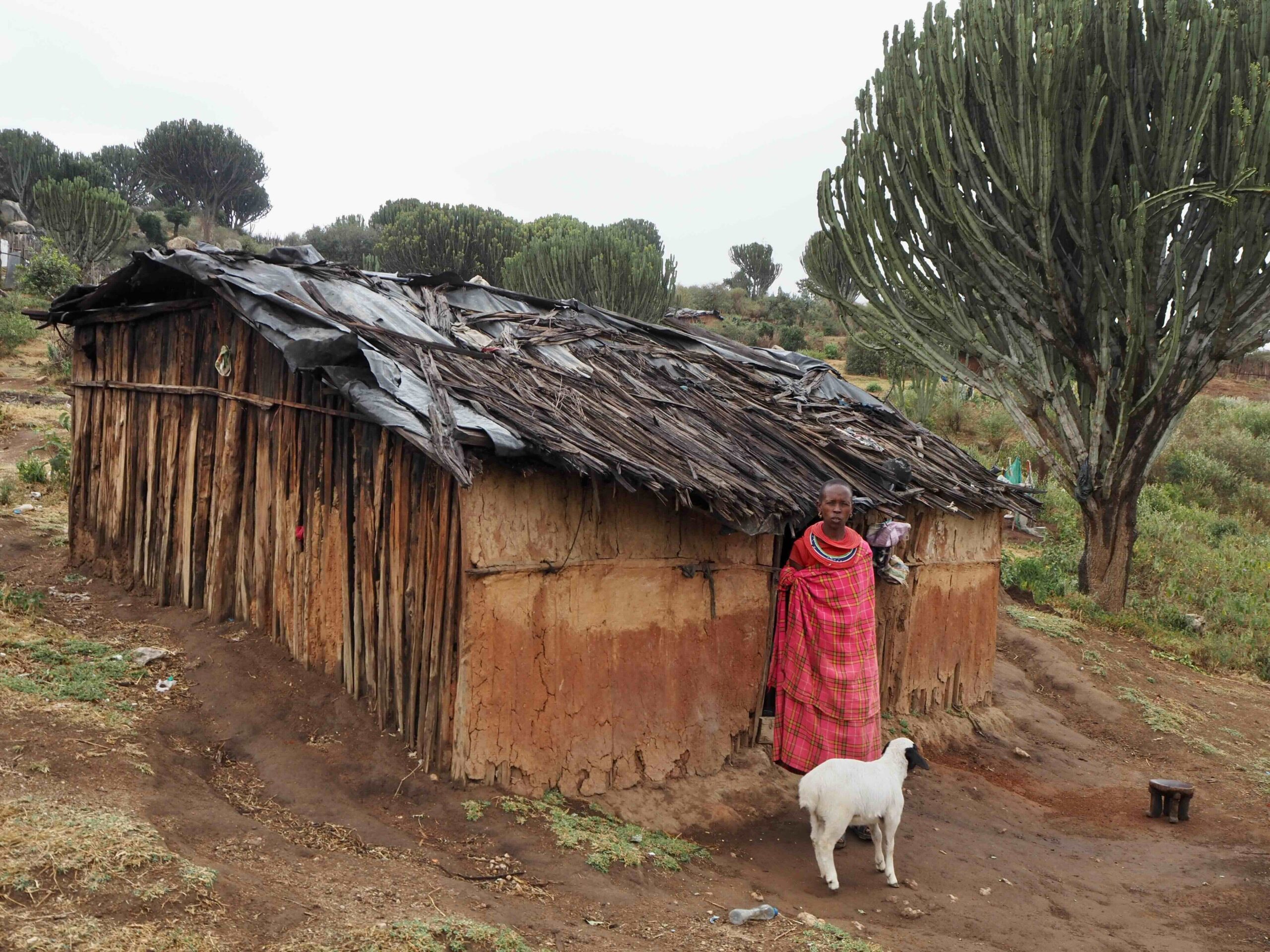
Image above: A woman and ex-forest dwellers displaced from the Kirisia Forest
Shinya Konaka (University of Shizuoka, Japan)
‘Nomads displaced by climate change narratives should also be recognised as “climate change refugees”’. This argument is proposed in a new article published in Climate and Development, entitled Relational approach to examine the cascading effects of climate narratives: Eviction cases of Samburu pastoralists and Dorobo Foragers in North-Central Kenya.
What comes to mind when you hear the term ‘climate refugee’? Do you think of fishermen who live on sinking Pacific Islands? Or might you think of miners in the polar regions suffering from permafrost thaw? Often, when we think of climate refugees, we overlook pastoralists. In this new article, based on two case-studies from Samburu County in Kenya, I argue that pastoralists and foragers undoubtedly belong to the category of “climate refugees”, even if they are rarely considered as such in academic literature. This is likely because even when their livelihoods are severely compromised by climate change, it is assumed that because pastoralists and foragers are mobile, climate change is not a problem. Consequently, notions such as ‘displaced nomads’ are dismissed as non-existent from the outset.
However, while mobile indigenous groups, such as pastoralists and foragers, are often forced to relocate because of the ‘climate change narratives’ that underlie sustainable development policies and projects, they remain ignored as ‘climate refugees.’ This study shows how such issues are unfolding among pastoralists and hunter-gatherers in north-central Kenya.
My study focuses on displaced Samburu pastoralists and Dorobo hunter-gatherers who now live on dwellings built on steep, previously uninhabited slopes at the edge of the Kirisia Forest. Once forest dwellers, these communities were forced to relocate to this harsh terrain.
In early 2020, they were forcibly evicted from the forest. In one example, in April 2020, government forces set fire to the dwellings of the remaining forest dwellers, compelling them to depart. The forest is now uninhabited, except for rangers.
The evictions were permitted because forest dwellers had been deemed forest destroyers. Removals were further exacerbated by the Kirisia Forest being designated as a National Important Forest as part of Kenya’s sustainable development policy formulated under pressure from Western donors.
However, evidence in my interviews with 40 evictees casts doubts on the claim that pastoralists and foragers destroyed Kirissia forest. Instead, these pastoralists and foresters assert that large-scale deforestation stemmed from extensive illegal commercial logging by timber traders coming from outside the region. In contrast, forest dwellers use only deadwood and rarely felled living trees. When asked why, they replied, ‘Trees have eyes; they watch people cutting them down and cast curses on them’.
Following the forced evictions, UN agencies distributed saplings to displaced forest dwellers as part of a climate-mitigation project. However, a drought soon struck, and all the distributed saplings died.
This case illustrates that the pastoralists’ customary practices, not afforestation, held real significance for forest conservation. Still, while the sapling project is treated positively as a sustainable development practice, the pastoralists’ customary practices are dismissed as superstitious.
The second case study explores how land privatization processes driven by local fears of decreasing resources under climate change also led to evictions and the creation of another group of climate refugees.
This article examines two cases of eviction from forests and rangelands in north-central Kenya. Each case highlights a new challenge: the phenomenon of nomads becoming climate refugees under mainstream climate narratives.
Read the article here: https://doi.org/10.1080/17565529.2025.2590718
Konaka, S. (2025). Relational approach to examine the cascading effects of climate narratives: Eviction cases of Samburu pastoralists and Dorobo Foragers in North-Central Kenya. Climate and Development, 1–14. https://doi.org/10.1080/17565529.2025.2590718

Image above: A family displaced from rangelands due to land subdivision.