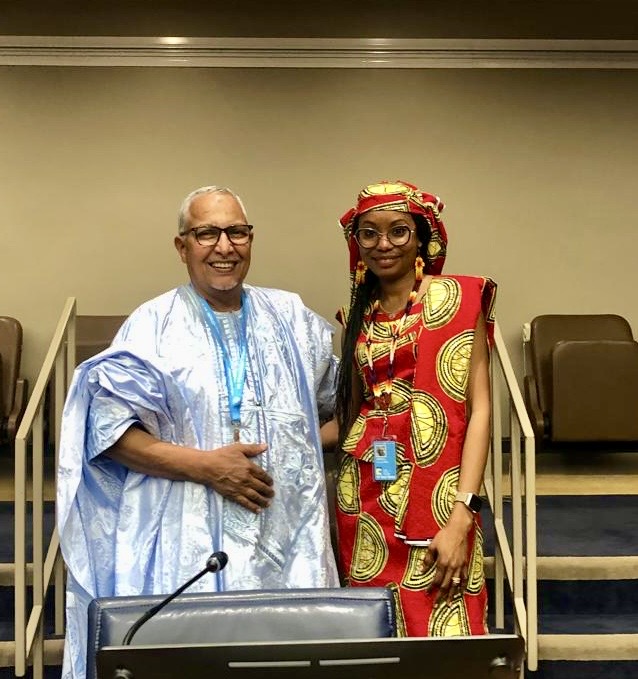
Photo above: Sibaouaih Mohammed Yahdih (Camel herder from Morocco) speaking with Ms Hindou Oumarou Ibrahim (Chad) President of the 23rd UNPFII
Professor Dawn Chatty (Refugee Studies Centre, University of Oxford) just published a new article on the French journal Nomopolis on mobile indigenous peoples and human rights. The article nicely summarizes the state of international law and policy regarding mobile peoples and does it in a non-jargonistic way. Share widely!
Article:
Link: https://nomopolis.org/nomopolis-03-mobile-indigenous-peoples/
Author: Dawn Chatty
Abstract: Mobile indigenous peoples (e.g. pastoralists, swidden farmers, and hunter-gatherers) have sustainably managed the lands they lived on for centuries. However, throughout the modern era and especially in recent decades, many have been displaced, dispossessed, and expelled from their traditional territories, forced to settle, and prevented from practising the forms of mobility upon which their livelihoods and social systems are based. These restrictions have left many destitute and have disrupted the cultural foundations of mobile indigenous identities. While the explicit aims of settling mobile peoples are no longer stated in the rhetoric of conservation and development, practical steps toward land restitution and mobility rights have not been forthcoming. Policy has not kept pace with advances in thinking about the relationship between mobile peoples, the state, and territory. Nor do states and international actors often live up to public declarations of concern for the human rights of mobile peoples. This article explicitly articulates the policy documentation in the Dana Declaration and the Dana + 20 manifesto which sets out to define and defend the rights of Mobile Indigenous Peoples. Yet even as rights holders, mobile indigenous peoples continue to be marginalised in policy and in practice. The problem for Mobile Indigenous Peoples is not that their rights are not beginning to be recognized by international human rights law but that these rights are not adequately upheld by national policies and laws and are often not respected by conservation agencies and corporate investors.