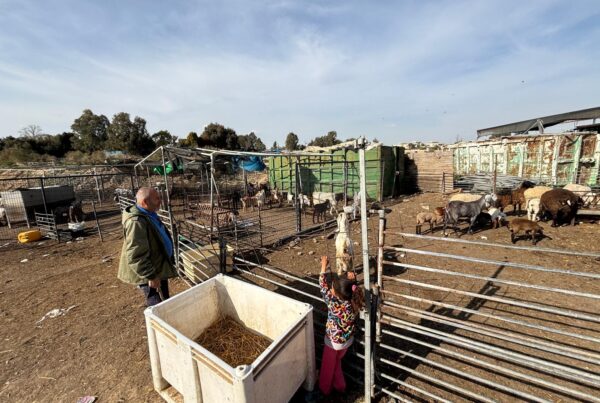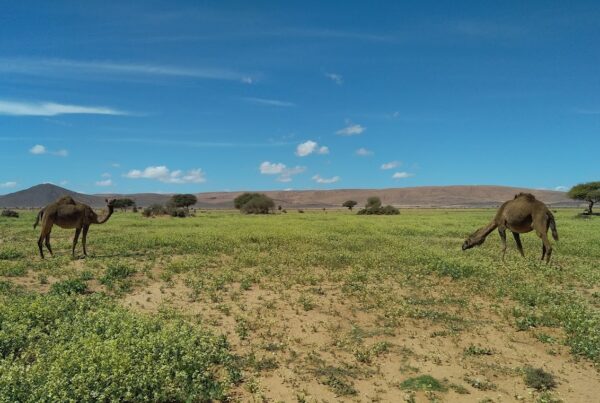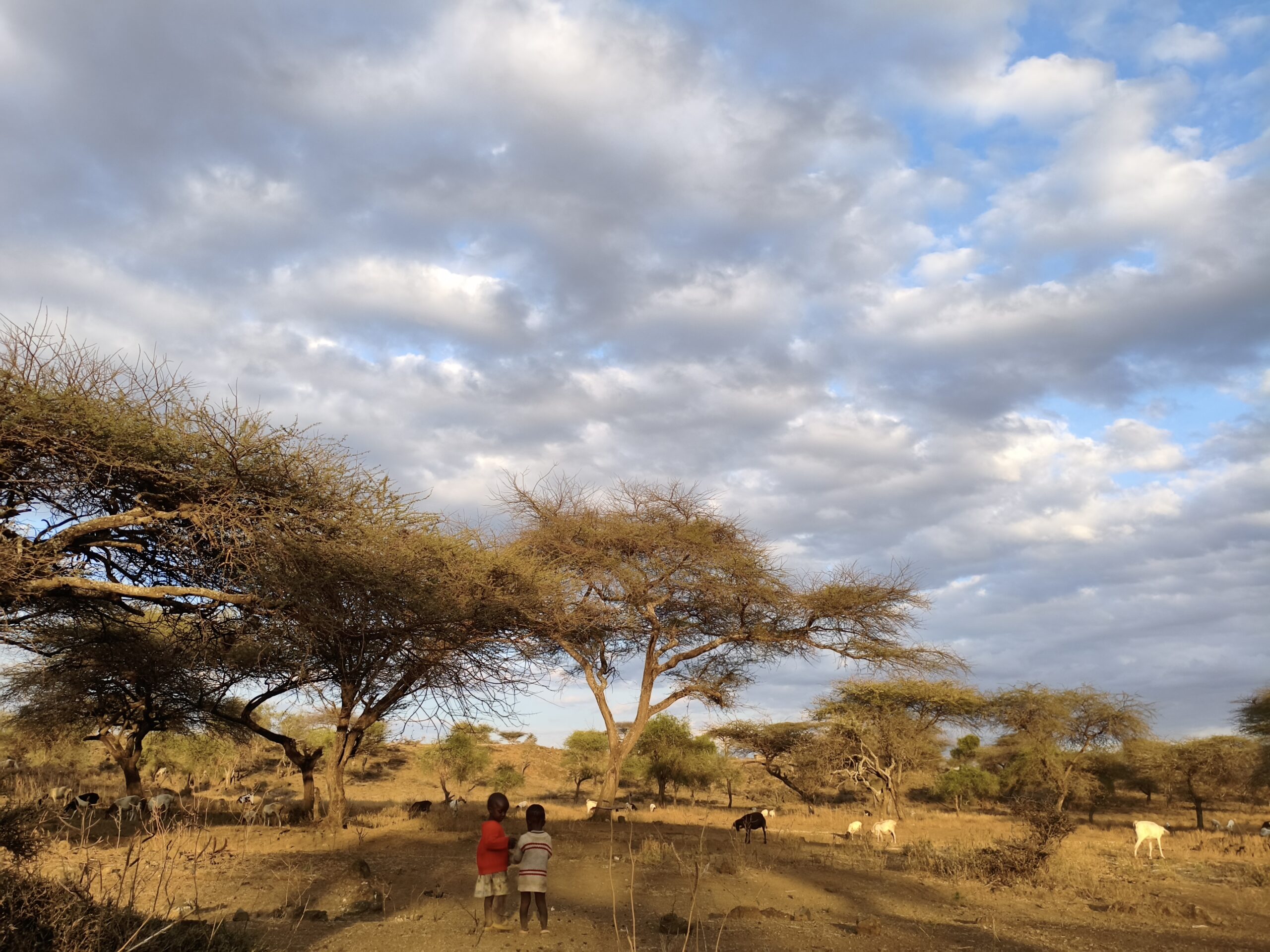
Image above: Toddlers watching juvenile goats and sheep. Photo by the author (2025).
Author: Xiaojie Tian (email: tian.xiaojie.fw@u.tsukuba.ac.jp), Associate Professor, Institute of Health and Sport Sciences, University of Tsukuba, Japan
Imagine handing a young child sole responsibility for his or her family’s assets. In most modern households, this idea is almost unthinkable. Most adults would assume that surely a child couldn’t manage such serious things, and shouldn’t have to. But what if a child could? And what if, somewhere, that trust were simply ordinary?
For a foreign visitor, the daily life of pastoralist children can be startling. Imagine an eight-year-old walking cattle across open grassland, reading the weather and the land, deciding alone which way to go. Following the idea that children should not be working contributors, one may criticize such hard labor being pushed onto the young. But seen through the lens of trust between children and caretakers, the same scene can be sketched in a very different way.
Maasai Childhood
The ethnography Maasai Childhood: The Rhythm of Learning in Daily Work and Play Routines (Palgrave Macmillan, 2024) grew out of a discomfort that kept surfacing in the field. So much of what the wider world assumes about pastoralist children—that they are “backward,” kept from school, missing out on a real childhood—simply doesn’t match the competent, busy, deeply knowledgeable children I came to know in this community. The book sets out to describe their routines of life and learning, and how childhood itself takes shape, on its own terms.
Maasai children are not treated as novices waiting to become useful adults; they are reliable contributors now. Two features of children’s ways of living make this possible. The first is a particular kind of independence, as each child is trusted to take their roles within a web of care from peers, parents, extended kin, and neighbors. Adults watch each child closely, gauge what they can handle, and entrust them with responsibility in careful stages—starting with infant goats and sheep near the homestead, and later moving on to entire herds and long solo herding journeys. An early study of pastoralist Turkana children has described such childhood with the term “full-fledged beings”. This phrase fits Maasai children and many others who grow up in pastoralist communities as well. The second is the absence of the line we draw so firmly between work and play. Children invent games, race, build toys, and chase after wildlife—in the same breath learning to track animals, judge risk, and read the land. As they wayfare alone or with peers across the land, they initiate and manage their activities as both play and work. Adults play minimal roles in directing these embodied experiences.
The way of learning of Maasai children is distinctive, embedded in such daily routines through direct contact with the world, in motion and with affection. A child does not memorize where the water lies or how an animal grows in a classroom; they come to know it by observing and walking the land themselves day after day. Their learning depends on being able to move freely across the land, for herding, collecting, or simply wayfaring on their own. When the land is fenced, fragmented, or lost, as is increasingly the case for the Maasai communities, what disappears with it is not only a livelihood but a whole way of learning and growing up.
Childhood Physical Activity and Embodied Learning
In a newly published paper (Tian et al. 2026), I further explored the means of embodiment in the growth of Maasai children by examining their physical activity (Tian 2026). Children in mobile, subsistence-based communities are seldom the focus of such research, and when their fitness is noticed, it tends to be misread through a Western lens—high activity taken as a sign of a “disadvantaged” life or of children burdened with heavy labor. Working with developmental epidemiologists, we recorded the physical activity of 180 Maasai children aged 2 to 18, across both weekdays and weekends.
The findings were clear. Maasai children were highly active at every age, and those between 6 and 12 logged some 17,000 to 21,000 steps a day, with over two hours of moderate-to-vigorous activity, which far exceeds what the World Health Organization recommends. The most telling detail was the weekend. Across much of the world, children slow down once the school week and its sports fall away. Maasai children did not; weekend wayfaring across the land sustains not only the embodied learning but also their physical activity across the whole developmental span.
This finding runs against a global trend of sharply declining activity through childhood and adolescence. Maasai children buck that trend, and the reason lies in a distinctive developmental niche. Maasai childhood rests on local parenting norms that value children’s autonomy. And it depends on the environment that makes it possible—a social web of care, and free access to land and resources.
Pastoralist Childhood Matters
The Maasai are not unique. Across pastoralist communities, children’s lives gently overturn a model of childhood that much of the world treats as natural and universal. In its place, pastoralist childhood offers something valuable. Yet we still know remarkably little about it. Child-focused ethnographic study of pastoralist communities remains scarce—far thinner than the research on children in farming or hunter-gatherer societies, and thinner still when it comes to how these children move, play, and learn through their bodies. That gap matters, and is worth further exploration.

The work-play of herding boys. Photo by the author (2025).
References
Tian, X. (2024). Maasai childhood: The rhythm of learning in daily work and play routines. Palgrave Macmillan. https://doi.org/10.1007/978-3-031-73780-0
Tian, X., Kidokoro, T., Mwangi, F. M., & Rintaugu, E. G. (2026). Childhood physical activity and developmental niche in contemporary pastoralist Maasai community in southern Kenya. American Journal of Biological Anthropology, 190(2), e70283. https://doi.org/10.1002/ajpa.70283